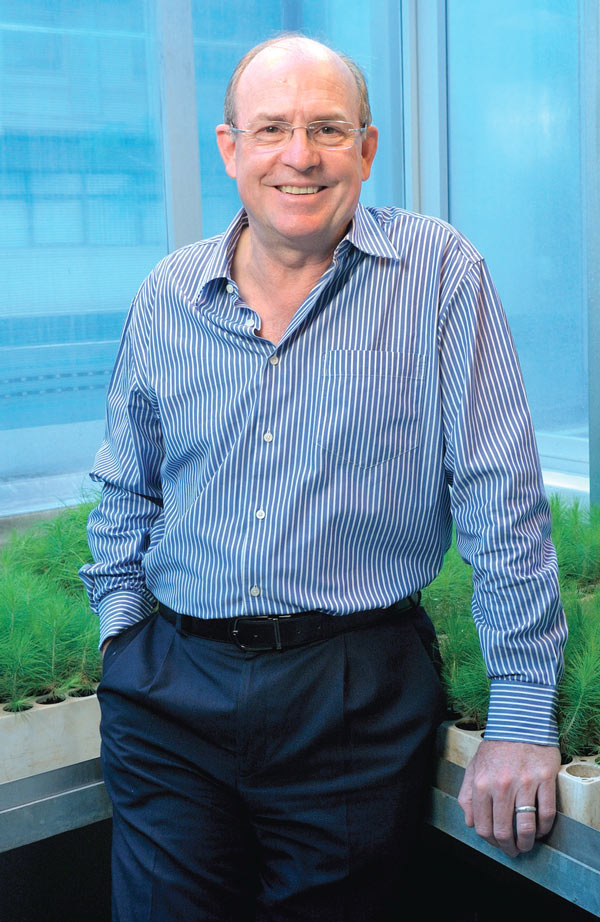
 Professor Mike Wingfield
In 2015 Professor Mike Wingfield published a review article in the journal Science with co-authors in the Forestry and Agricultural Biotechnology Institute (FABI) – Professors Brenda Wingfield and Bernard Slippers, and Dr Eckehard Brockerhoff, the principal scientist at Scion in New Zealand.*
The authors propose a global strategy that would include several critical actions and focus on an integrated approach to the understanding, surveillance and control of key pests, rather than focussing on single-country strategies.
Why is such a wide-ranging global strategy necessary? Forests and woodland ecosystems worldwide are under threat from insect pests and fungal pathogens (or simply pests), despite the best biosecurity efforts. The article describes that the most rapidly changing of these threats is as a result of anthropogenic influences that directly and indirectly impact on the distribution and patterns of interaction between trees and pests. Without a concerted global effort to understand and control invasive pests, the rising trend in their emergence is expected to continue, threatening the sustainability of forests and forestry.
Planted forests are particularly vulnerable to invasive organisms as they are typically of a single and non-native species. They cover vast areas – currently 7% of global forests – and have become part of the natural resource. An analogy is made with agricultural crops as planted forests now support major industries.
At FABI there are several programmes that address the problem of insect pests and fungal pathogens from different dimensions. This includes research undertaken by several research groups, as well as: The Chair in Forest Genomics and Biotechnology; The Centre of Excellence in Tree Health Biotechnology; The Tree Protection Cooperative Programme; Eucalyptus and Pine Pathogen Interactions.
The Tree Protection Cooperative Programme and the Centre of Excellence in Tree Health Biotechnology have focused on the ecology and evolution of insects and microorganisms that affect tree health, and on the development of tools to mitigate their impact.
*MJ Wingfield, EG Brockerhoff, BD Wingfield, B Slippers (August 20, 2015). Planted forest health: The need for a global strategy, Science. 349 (6250), 832-836.